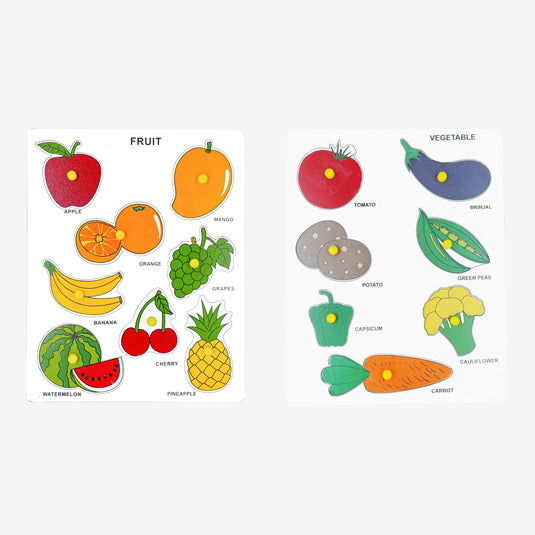
Knob puzzles — wooden boards with a small peg on each piece for lifting it out — are one of the most quietly effective preschool toys, and a fruits and vegetables version adds a genuinely useful real-world vocabulary lesson on top of the usual motor benefits.
Why the Knob Matters More Than You'd Think
Regular flat puzzle pieces are picked up with a whole-hand grasp. A knob forces a child to use a precise pincer grip — thumb and forefinger — to lift each piece out. This small design detail is deliberate: pincer grip is the exact hand movement children later need for holding a pencil, so knob puzzles are quietly building handwriting readiness long before a child touches a crayon.
- Pincer grip development — direct preparation for pencil grip
- Food vocabulary — naming real fruits and vegetables builds practical, everyday language
- Shape and colour matching — placing each piece in its correctly shaped outline
- Independent completion — self-correcting design means a child can succeed without constant adult help
How to Extend the Learning
- Connect it to real food. Next time you're cooking or grocery shopping, point out the same fruits and vegetables from the puzzle — this bridges toy-based learning to real life.
- Talk about colour and category. “This one's a fruit, this one's a vegetable” introduces early categorisation, a genuine pre-maths and pre-science skill.
- Time-free practice. Avoid turning it into a timed race — let your child work through the pincer grip challenge at their own pace.
- Mix up the order. Once a child knows the puzzle well, mix which pieces are placed first to keep the challenge from becoming rote memorisation.
Why “Self-Correcting” Design Is a Big Deal
Because each piece only fits in its matching outline, a child gets instant, judgment-free feedback — no parent needs to say “no, wrong spot.” This lets children build genuine independence and self-confidence in problem-solving, which matters more for long-term motivation than adult praise alone.
Best Age Range
Knob puzzles are typically appropriate from around 18 months through age 3-4, with the specific fruits and vegetables theme working especially well once a child is also learning basic food vocabulary.
Tantrums' Wooden Fruits and Vegetables Knob Puzzle features bright, realistic shapes on a sturdy wooden board.