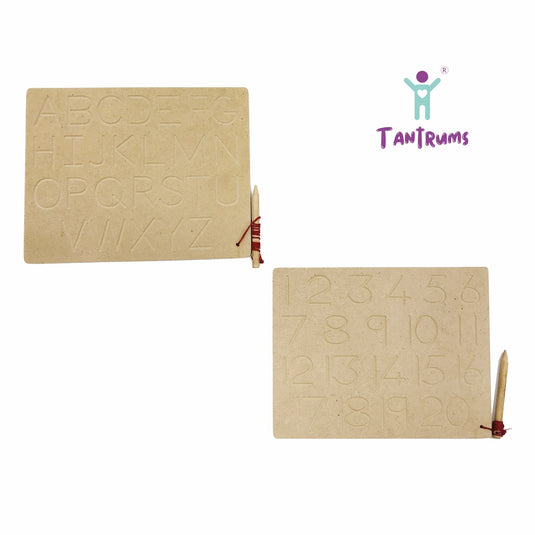
Long before a child can write letters neatly on paper, their hand and brain need practice with something more fundamental: controlled, directional movement. A wooden tracing board — grooved letters and numbers a child traces with a finger or stylus — is one of the most effective, low-pressure ways to build that skill.
Why Tracing Comes Before Writing
Handwriting is a genuinely complex motor skill — it requires the right grip, the right pressure, and precise directional control, all at once. A tracing board strips away the pressure and grip variables and lets a child focus purely on direction: which way does this letter curve, where does this line start and end. This builds the muscle memory that makes actual handwriting far less frustrating once a child picks up a pencil.
- Pre-writing motor control — directional finger movement in a guided, forgiving format
- Letter and number shape recognition — repeated tracing builds strong visual memory of each shape
- Sound-symbol connection — saying the letter's name or sound while tracing links the visual shape to language
- Confidence before pencil-and-paper writing — mastering the shape here removes a layer of difficulty later
How to Use It Effectively
- Trace with a finger first, stylus later. Bare-finger tracing builds tactile memory before introducing a tool, which adds its own grip challenge.
- Say it as you trace. “A — a-a-apple” while tracing the letter A links shape, sound, and word together.
- Follow the natural stroke direction. Most boards are grooved to guide the correct starting point and direction — follow this rather than letting a child trace “backwards,” since that habit can be hard to unlearn later.
- Alternate letters and numbers. If your board has both, switching between them keeps the activity fresh and reinforces that these are two different but related symbol systems.
A Gentle Alternative to Handwriting Worksheets
Many parents jump straight to pencil-and-paper worksheets, which can be frustrating for a child whose fine motor control isn't quite there yet. A tracing board removes the pencil-grip challenge entirely, letting a child succeed at the “direction and shape” part first — success that builds confidence rather than the frustration that early worksheets can sometimes create.
Best Age Range
Most children get real value from tracing boards starting around age 3, continuing to build handwriting readiness through age 5, right up to when they begin formal pencil-and-paper writing practice.
Tantrums' Tracing Board features alphabet letters on one side and numbers on the other, with smooth, deep grooves designed for confident finger tracing.