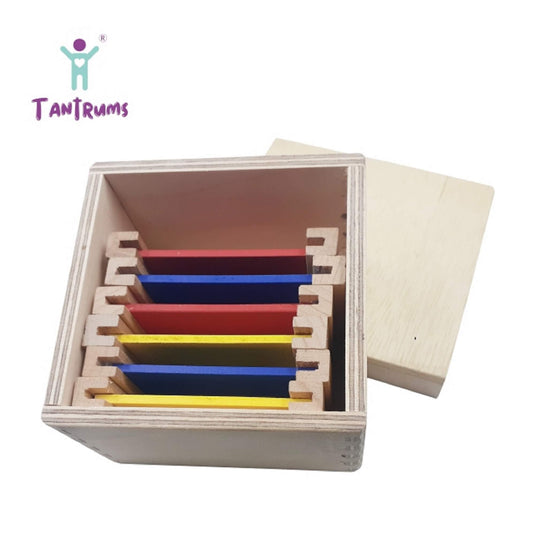
Ask most adults to name the colours their toddler should learn, and they'll say “red, blue, yellow, green” and stop there. Montessori Colour Tablets push a little further — introducing not just primary colours but subtle shade gradations — and in doing so, quietly train a skill most colour-learning apps and flashcards skip entirely: visual discrimination.
More Than “Name That Colour”
Colour Tablets aren't just about identifying red versus blue. The real value shows up once a child starts working with graded sets — several shades of the same colour family, arranged from lightest to darkest. This asks the brain to do something more sophisticated than simple recognition: comparison and fine visual discrimination, the same underlying skill used later in reading (distinguishing similar-looking letters) and maths (comparing quantities).
Regular play with colour tablets supports:
- Visual discrimination — noticing subtle differences between similar shades
- Colour vocabulary — moving beyond basic colour names to words like “lighter,” “darker,” “more/less vivid”
- Sequencing skills — arranging tablets from lightest to darkest is a form of ordering, similar to size-based seriation
- Sensory calm — many parents find this a soothing, low-stimulation activity compared to louder toys
How to Use Them at Home
- Start with matching, not naming. Before asking “what colour is this,” simply ask your child to find the tablet that matches a given one. Matching is an easier first skill than recall.
- Move to grading. Once matching is easy, introduce ordering — “can you put these from lightest to darkest?” This is where the real cognitive stretch happens.
- Connect it to the real world. Take the tablets around the house and match them to real objects — a cushion, a fruit, a piece of clothing — to reinforce that colour exists everywhere, not just on the toy.
- Keep sessions short. This is a concentration-heavy activity; 10-15 focused minutes is often more valuable than 40 minutes of distracted play.
Why This Matters More Than It Seems
Colour discrimination might sound like a minor skill, but it's a genuine building block for later academic tasks — distinguishing between similar letters (b/d, p/q), noticing patterns in maths, and even skills like map-reading and art. Starting this kind of fine visual discrimination early, through low-pressure play, gives children a head start without it ever feeling like “learning.”
Best Age Range
Simple colour matching can start as early as 2 years old. The more advanced grading and sequencing activities are typically best suited to children aged 3 to 5, once attention span and fine motor control have developed further.
Tantrums' Wooden Colour Tablets are designed with smooth, non-toxic finishes in graded primary and secondary shades, built for repeated daily handling.