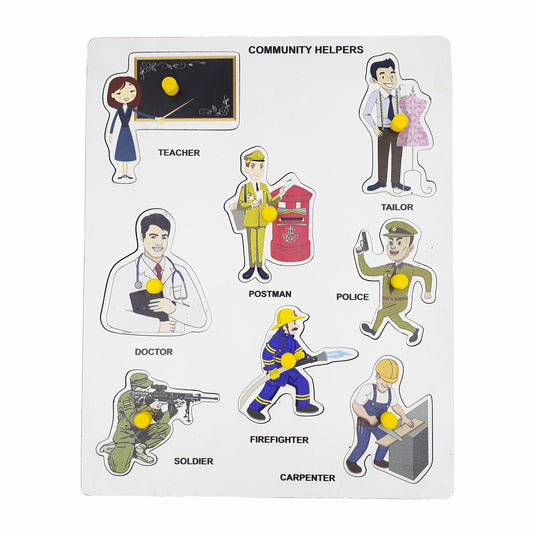
Ask a young child what a doctor, farmer, or firefighter actually does, and you'll often get a surprisingly vague answer. A community helper puzzle gives shape to these roles — literally — helping children understand the different jobs that make up the world around them.
Why Occupation Awareness Matters Early
Understanding that different people play different roles in a community is a genuine social-studies concept, and it's one children start absorbing far earlier than we might assume. A community helper puzzle turns abstract job titles into concrete, visual, hands-on pieces — making “what does a firefighter do” something a child can hold and talk about, not just hear about.
- Occupation vocabulary — learning names and roles of common community jobs
- Social awareness — understanding that a community is made up of different, interdependent roles
- Fine motor skills — the standard grip and placement practice of any knob puzzle
- Empathy building — early appreciation for the people who help in daily life
How to Use It at Home
- Talk about what each helper does. “What does a doctor do when you're sick?” turns each piece into a small conversation about real-world roles.
- Connect to real experiences. After a doctor's visit or seeing a firefighter, revisit the matching puzzle piece to reinforce the connection between play and real life.
- Role-play afterward. Once the puzzle is done, acting out “being a doctor” for a few minutes extends the learning into imaginative play.
- Ask “who helps you?” questions. Broaden the conversation to people who help your own child specifically — teachers, family members, neighbours — not just the puzzle's professions.
Building Early Empathy and Gratitude
Beyond vocabulary, this kind of puzzle plants an early seed of appreciation — understanding that community helpers exist to support others is a gentle first step toward empathy and gratitude, concepts that become more meaningful as children grow older.
Best Age Range
Most children engage meaningfully with community helper puzzles from around age 3, when social awareness and real-world curiosity are actively expanding.
Tantrums' Wooden Community Helper Puzzle features colourful figures representing common community roles on a sturdy wooden board.