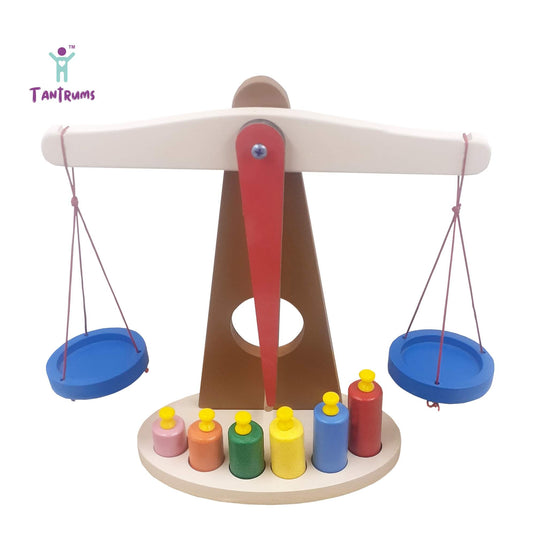
Long before a child sits through a formal maths or science class, they can start understanding two of its most fundamental ideas — balance and comparison — through nothing more than a wooden see-saw and a handful of coloured weights. That's the entire premise of the Wooden Weighing Balance, and it's a surprisingly deep toy for something this simple.
The Big Idea: Learning Through Physical Feedback
When a child places a weight on one side of the balance and watches it tip, they're not just playing — they're building an intuitive, physical understanding of concepts like “heavier than,” “lighter than,” and “equal to.” This is what educators call concrete learning: understanding an abstract idea (comparison, equality) through a hands-on, physical experience before ever meeting it in a textbook.
This single toy touches on several developmental areas at once:
- Early maths reasoning — comparison, estimation, and cause-and-effect prediction (“which side will go down?”)
- Fine motor skills — picking up and placing small weights precisely
- Colour recognition and sorting — most sets include multicoloured pieces that can be grouped and counted
- Scientific curiosity — the basic idea of a scale is the same one used in real science and cooking
How to Use It at Home (Beyond Just “Play With It”)
- Start with prediction. Before your child places a weight, ask “which side do you think will go down?” This turns free play into a guessing game that builds reasoning skills.
- Count together. “How many weights do we need on this side to make it balance?” is a great early counting and problem-solving prompt.
- Bring in household objects. Once your child understands the toy, try weighing small household items against each other — a spoon vs a toy car, for instance — to extend the concept beyond the toy's own pieces.
- Talk through the vocabulary. Use the words “heavier,” “lighter,” “equal,” and “balance” consistently — repetition is how these words become part of a child's working vocabulary.
Why This Beats a Worksheet
You could try to teach “heavier and lighter” with a worksheet and pictures, but a 3-year-old will retain almost none of it. Give them a balance scale and let them physically watch one side drop under real weight, and the concept sticks — because they experienced it, not just heard about it. This is the core Montessori principle behind almost every toy in this category: understanding through the hands before understanding through words.
Best Age Range
Most children get real value from a weighing balance from around 2.5 to 3 years onward, once they have the fine motor control to place pieces precisely and enough language to start following simple prediction questions. It remains useful well into the pre-school years as counting and comparison concepts get more advanced.
Tantrums' Wooden Weighing Balance comes with a set of colourful wooden weights, built on a sturdy natural-wood base designed to withstand enthusiastic daily play.