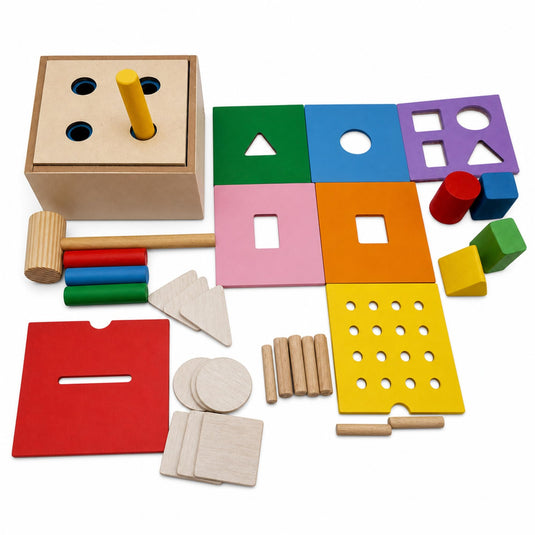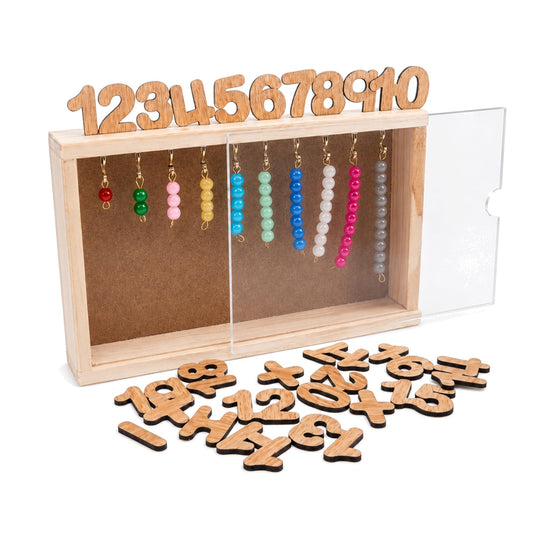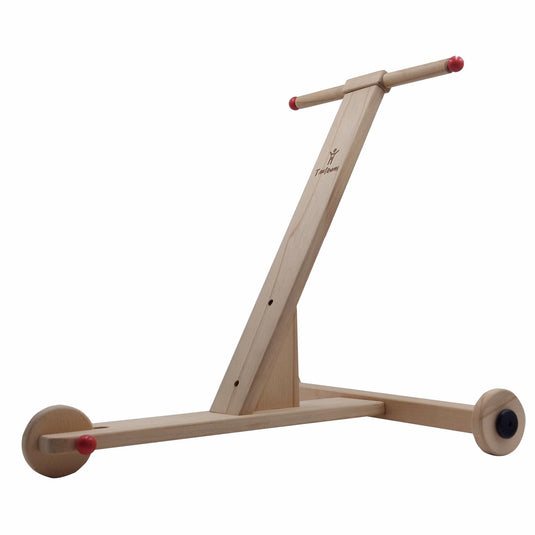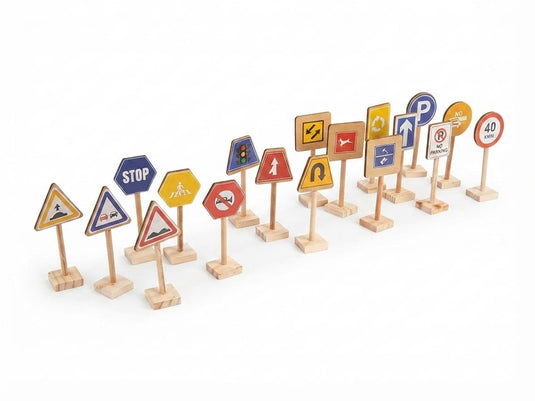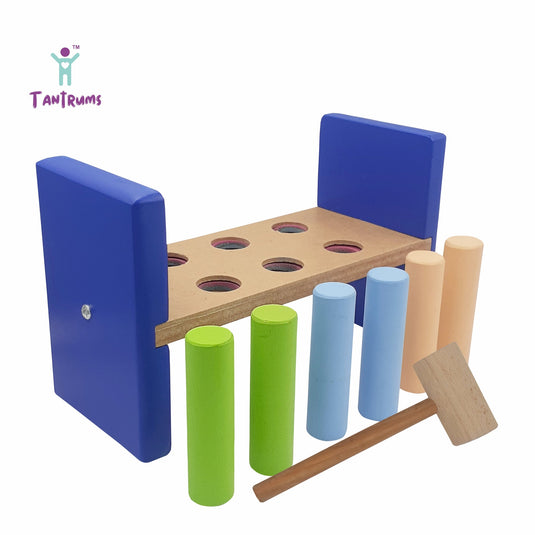
There's a reason “hammer and peg” toys have stayed a nursery staple for generations — they let a toddler do something that feels genuinely satisfying: hit something with a tool and watch it work. The Wooden Cobbler Bench takes that basic urge and turns it into focused, skill-building play.
What Hammering Actually Teaches
Pounding pegs through holes with a mallet looks like simple fun, but it's asking a toddler's brain and body to coordinate several things simultaneously:
- Hand-eye coordination — aiming the mallet accurately at a specific peg
- Grip strength and control — holding and swinging a small mallet with the right amount of force
- Cause and effect — seeing the peg move down with each accurate strike
- Focus and persistence — getting all six pegs through takes sustained attention
A Healthy Outlet, Not Just a Toy
Toddlers often have big physical energy and limited ways to release it constructively. A hammering toy gives that energy somewhere productive to go — it's genuinely satisfying to hit something repeatedly, and here that instinct is channelled into a skill-building activity rather than, say, hitting furniture or siblings.
How to Use It at Home
- Show the grip first. Demonstrate holding the mallet near the head for better control, rather than at the very end of the handle.
- Let them find their own rhythm. Some children want to hammer every peg down fast; others go slowly, one at a time. Both are fine — the value is in the repeated motion either way.
- Flip and repeat. Most cobbler benches let pegs be pushed back up from the other side — flipping it over doubles the play value and adds a bit of extra problem-solving.
- Count together. “One peg down, how many left?” turns hammering into a quick counting exercise too.
Safety Notes for Parents
Because this toy involves an actual mallet, adult supervision matters more here than with passive toys — mostly to keep the hammering aimed at the pegs rather than nearby siblings or furniture. Look for a sturdy, weighted base so the bench doesn't slide or tip during enthusiastic play.
Best Age Range
Most toddlers can start engaging with a cobbler bench from around 18 months, with the activity remaining genuinely engaging through age 3 as grip control and precision improve.
Tantrums' Wooden Cobbler Bench features 6 sturdy pegs and a smooth, weighted base built to handle daily hammering.