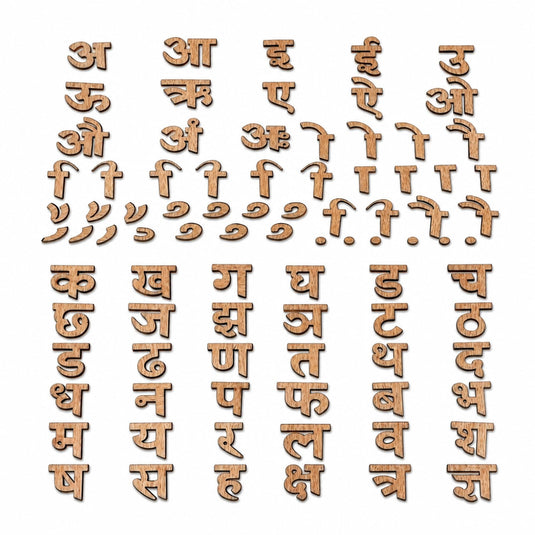
English-first learning materials are everywhere, but Hindi — despite being the language most Indian children hear at home from their grandparents, or speak in daily life — often gets left out of “educational toy” shelves entirely. A wooden Hindi Varnamala set is one of the few hands-on tools built specifically to close that gap.
Why Mother-Tongue Learning Matters Early
Child development research consistently shows that strong literacy in a child's home language supports — rather than competes with — later learning in a second language like English. A child who can confidently recognise and form Hindi swar (vowels) and vyanjan (consonants) is building the same phonemic awareness skills that transfer to reading in any language.
A wooden, movable-letter Varnamala set specifically supports:
- Letter recognition — seeing and touching the actual shape of each character repeatedly
- Fine motor control — picking up, placing, and tracing small wooden letters
- Early literacy foundations — associating shape with sound, which is the basis of all reading
- Cultural and linguistic identity — giving equal weight to Hindi alongside English in a child's early education
How to Use It at Home
- Start with familiar letters. Begin with letters from your child's own name or common words they already say, rather than working strictly alphabetically.
- Say it, don't just show it. Every time a letter is picked up, say its sound out loud. Hearing and seeing together builds the sound-symbol connection faster than either alone.
- Trace before you build. If your set includes tracing boards or grooved letters, let your child trace with a finger before attempting to write — this builds the muscle memory for handwriting later.
- Build simple words together. Once a child knows a handful of letters, try arranging them into short, familiar words — their name, “maa,” “papa” — to show letters have real meaning, not just sounds.
A Note for Bilingual Households
If your child is already learning English letters at school or through other toys, introducing Hindi letters at home doesn't create confusion — children are remarkably good at compartmentalising different writing systems once they understand these are “different languages,” much like they naturally switch between speaking Hindi and English in conversation. In fact, many parents find that having a dedicated Hindi learning toy at home reinforces that Hindi is just as valued as English in their child's education.
Best Age to Start
Most children begin engaging meaningfully with letter shapes and sounds from around age 3, continuing to build fluency through age 5-6 as they move toward reading full words and simple sentences.
Tantrums' Wooden Hindi Varnamala Alphabet Set includes movable swar, vyanjan, and punctuation marks, crafted from smooth, child-safe wood.